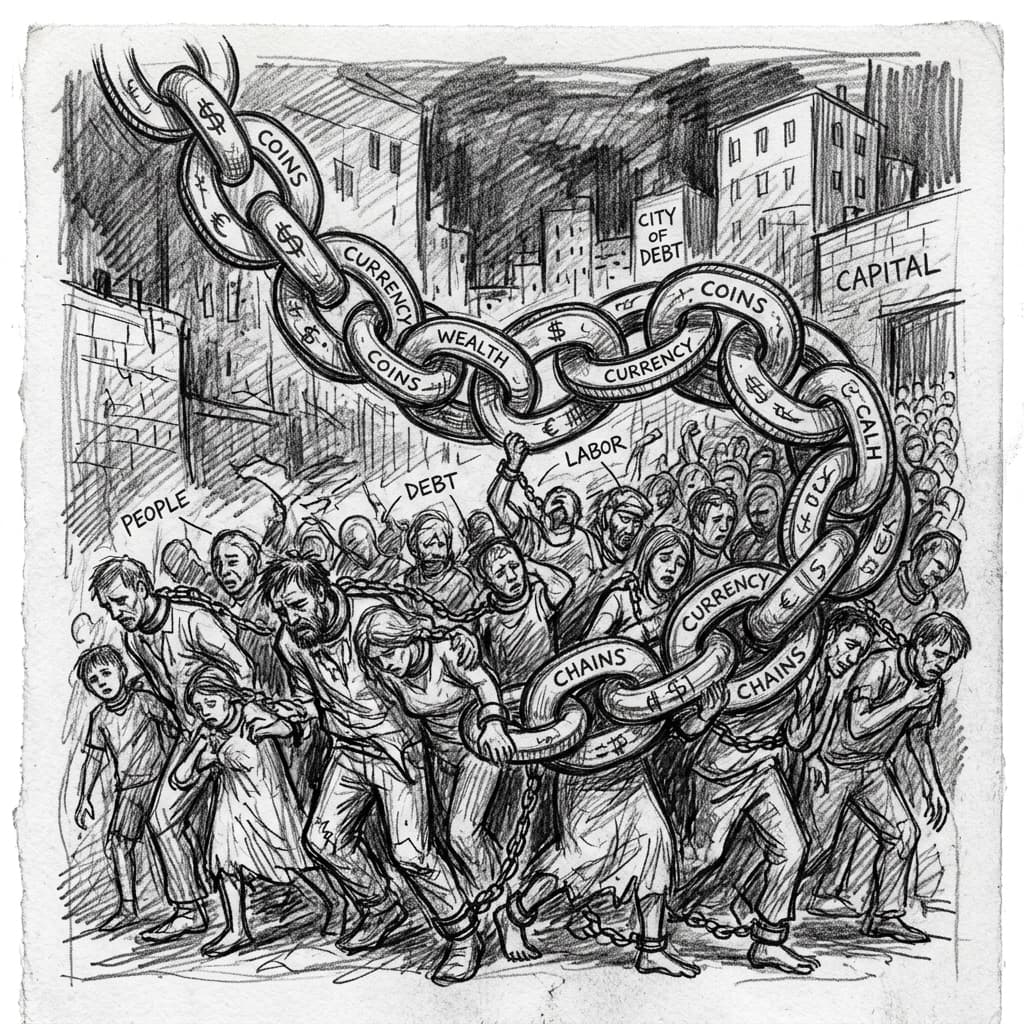
The masterful corpus of the Social Doctrine of the Church has sustained an ontological and historical condemnation regarding an economic perversion that today dominates the world, but that the contemporary lexicon has intentionally proscribed: the sin of usury. The international financial architecture, hegemonized by issuing central banks and stateless corporations, has institutionalized the generation of fiduciary money ex nihilo (from nothing) through credit, inducing states, families and intermediate bodies into a model of mathematical and inescapable servitude.
Faced with the foundations of the real economy—based on human labor, the production of tangible goods and the objective generation of value—modernity has enthroned a speculative macroeconomy of a parasitic nature. This globalist techno-capitalism operates outside of national loyalties and the Common Good; Its only axiom is the infinite accumulation of abstract capital. The externalities of this model are devastating: the middle class is pulverized by inflation (a hidden and iniquitous tax), while transnational monopolies monopolize land, strategic resources and the means of production on a planetary scale.
Distributism, lucidly formulated by G.K. Chesterton and Hilaire Belloc, under the protection of the encyclical Rerum Novarum, prophesied the arrival of the Servile State. A regime where the overwhelming majority of citizens, expropriated of all productive tenure, would existentially depend on state assistance or subsistence wages set by the oligopolistic plutocracy. This economic dystopia constitutes our political cartography today.
It is an intellectual duty to dismantle the false dialectic between state interventionist socialism and uprooted financial capitalism, warning that both ideologies emanate from the same materialist root. Authentic civil and political sovereignty unavoidably requires the restoration of private property distributed on a human scale, the strengthening of economically autonomous families and the frontal challenge of a usurious system that confiscates the future of nations under the weight of debt.
Lic. Juan Pablo Torres-Lozano Doctor in Metaphysics and Ecclesiastical Philosophy. Graduate in Political Science and Sociology.
Legal Note: This critical analysis is carried out under the protection of Art. 28 (news of general interest) and Art. 10 (right of citation) of Law 11,723 on Intellectual Property of the Argentine Republic. The original work and its title belong to its respective author and publication medium, cited on this page.