
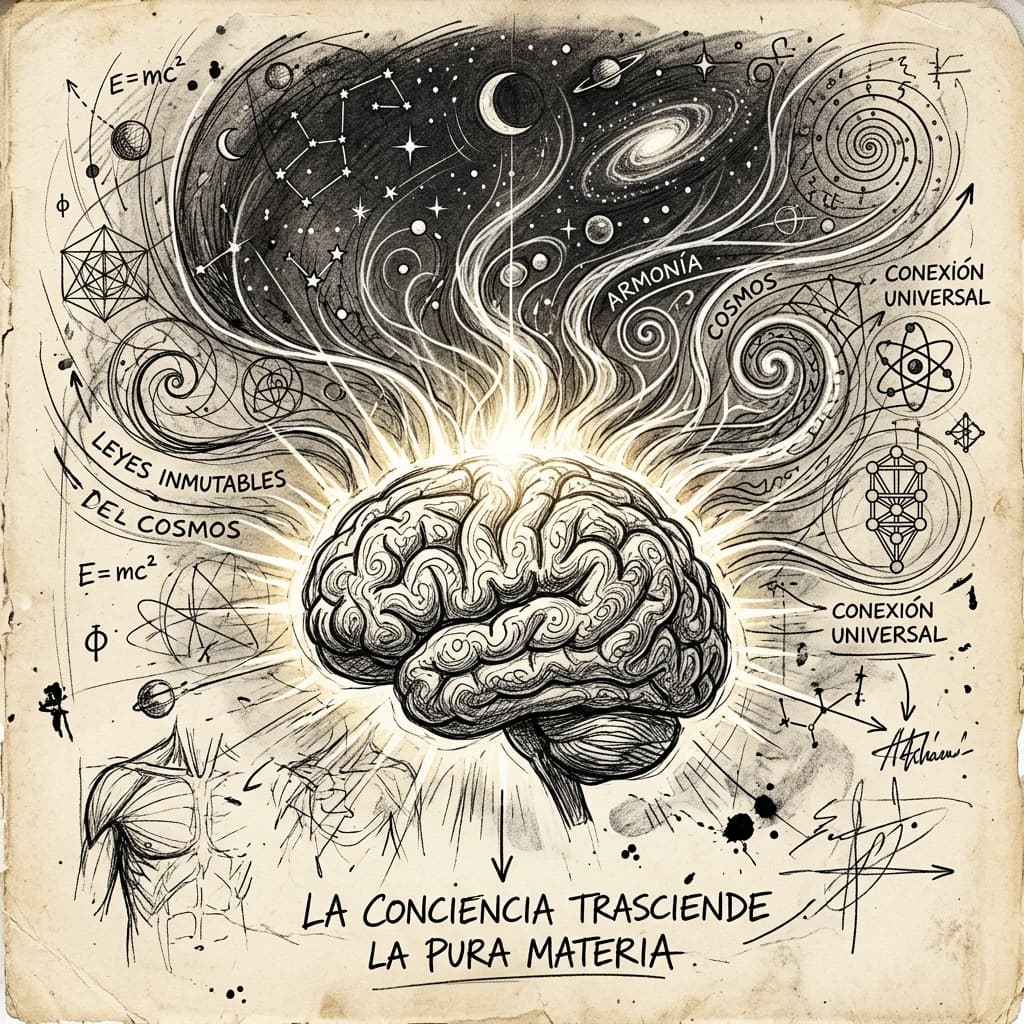
The contemporary scientific debate around artificial intelligence and neuroscience is imprisoned by a reductionist dogma that few academies dare to subject to logical rigor: the superstition that the human being is nothing more than a highly elaborate biochemical and computational machine. According to this hegemonic narrative, insistently promoted by global technology corporations and the elites of modern transhumanism, human consciousness would be a mere epiphenomenon derived from the trafficking of electrochemical impulses through the neuronal synapse. If such a premise were accepted, a disturbing conclusion would be imposed: it would be enough to increase the computing power of microprocessors and integrate synthetic neural networks into the organic anatomy to decipher, replicate and finally "improve" the essence of the person in an inorganic support.
However, when this postulate is examined with the mathematical severity of modern physics and classical neurobiology, the conceptual edifice of transhumanism completely falls apart. Scientific reductionism deliberately confuses the instrumental cause with the fundamental ontological principle. To affirm that the brain is the mechanical origin of thought and moral freedom for the simple fact that all cognitive activity exhibits observable neurological correlates is equivalent to maintaining that a musical instrument composes the symphony it projects or that a radio wave receiver generates music in its own transistor circuit.
Updated quantum physics, enriched by the tradition of analytical thinkers who have explored the frontiers of the cosmos and matter with absolute experimental probity, demonstrates that the ultimate reality of nature does not obey the closed mechanism of the nineteenth century. Matter is not an inert or deterministic block that assembles into blind causal chains to spontaneously produce self-consciousness. On the contrary, quantum indeterminacy and entanglement phenomena show that the universe rests on a relational and immaterial order where information and the informing act precede measurable substance. In this ontological framework, attempting to reduce internal qualitative experience—the perception of pain, the contemplation of beauty, the discernment of truth, and the experience of selfless love—to a pattern of bytes in a silicon matrix represents a formal categorical absurdity.
There is an unbridgeable epistemological gap between syntax calculation and semantic understanding. Contemporary artificial intelligences, no matter how sophisticated their algorithmic statistics may be, absolutely lack interiority and genuine intentionality; They manipulate signs lacking their own meaning according to parameters codified from the outside. Human understanding, on the other hand, abstracts universal essences from contingent particulars, issues free moral judgments and transcends the physical conditions of the temporal instant in each rational act. This immaterial capacity for reflection on one's own being cannot arise from the simple quantitative accumulation of logical switches.
The ideological insistence on the man-machine does not respond to the true advance of empirical science, but rather to a sociological and anthropological utilitarianism of extreme gravity. By denying the spiritual irreducibility of the human person and defining it as a programmable material aggregate, the way is paved for the technical instrumentalization of life in all its stages. If the person is nothing more than an optimizeable biological algorithm, the infinite and inviolable value of each individual is subject to utilitarian criteria of efficiency, productivity or physical quality. Faced with this mechanistic assault, the work of honest neuroscience consists of vindicating the intrinsic dignity of the human being as an unrepeatable treasure, recognizing that the brain operates as the admirable organic substrate that accompanies, but does not imprison, the higher exercise of thought and freedom.
Legal Note: This critical analysis is carried out under the protection of Art. 28 (news of general interest) and Art. 10 (right of citation) of Law 11,723 on Intellectual Property of the Argentine Republic. The original work and its title belong to its respective author and means of publication, cited on this page.