
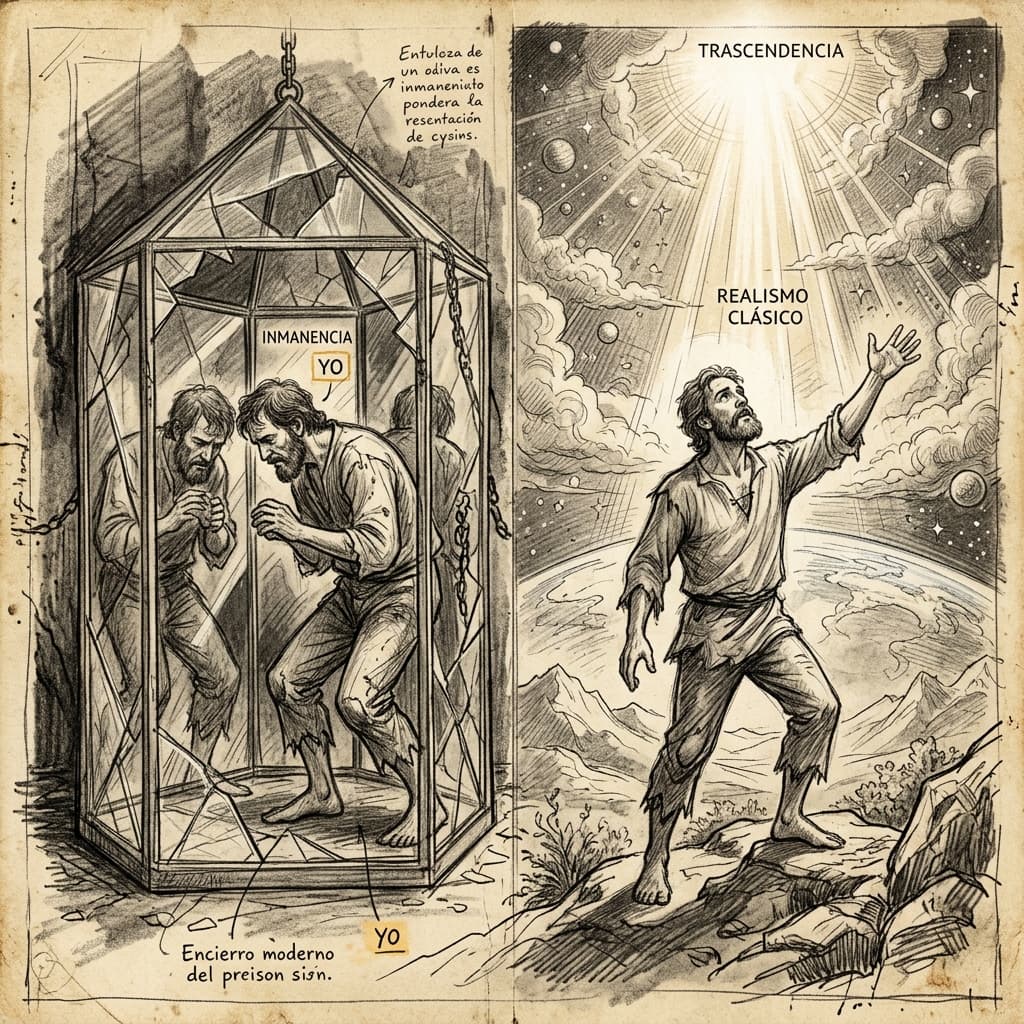
The great intellectual, moral and spiritual drama of contemporary civilization is not understood in all its magnitude if its deep origin is not traced in the field of philosophy. Today we are witnesses of a generalized confinement: modern man lives trapped in his own passions, in the dictatorship of his momentary emotions, in the absolute relativism of truth and in the disintegration of all transcendental meaning. Institutions, modern science, art and politics seem to converge in the same abyss of emptiness, leaving new generations orphaned of any solid anchorage. This tragedy is neither a mere "sociological accident" nor a spontaneous phenomenon of material progress. It is the logical, direct and unavoidable consequence of the historical triumph of a specific and lethal current of thought: immanentist philosophy.
In order to confront this structural decay, it is imperative that men of good will understand, with absolute pedagogical clarity and analytical rigor, what exactly this intellectual poison consists of, how it was developed over the centuries and, above all, how it is diametrically opposed to the fundamental pillar on which Christian civilization was built: classical realism. It is time to turn on the light of healthy metaphysics again to dispel the darkness of the self-enclosed ego.

The term "immanence" comes from the Latin "in-manere", which means, in its most literal sense, "to remain within." In the history of ideas, immanentism is that philosophical system or epistemological position that postulates that reality, knowledge and entire existence are exhausted and enclosed within the limits of the material world itself, of the human mind itself or of the thinking subject itself. For immanentism, there is nothing "beyond" (transcendence). Everything begins and ends in man himself, in his perception, in his consciousness or in purely temporal matter.
The starting point of this colossal error is found at the dawn of the so-called "philosophical modernity", and its undisputed father is René Descartes. By stating his famous axiom "I think, therefore I am" (Cogito, ergo sum), Descartes made a seismic fracture in the history of human intelligence. Subtly but devastatingly, he shifted the focus of philosophical attention from "the thing that exists" to "the subject who thinks the thing." Descartes locked the human mind in the dungeon of its own ideas. From there, man no longer looks in wonder at the created order to know it objectively, but rather obsessively looks at his own mental processes, doubting the very existence of external reality.
The following steps of immanentism were built on this epistemological crack. Baruch Spinoza took this confinement to the extreme of pantheism, declaring that there is no transcendent Creator God (distinct from the world he created), but that God and the universe are exactly the same substance ("Deus sive Natura"). If God is the material world, then there is no external salvation, no higher eternity, only the fatalistic chain of immanent physical laws.
But it was Immanuel Kant who sealed the death trap of immanentism with what he himself pompously called his "Copernican turn." Kant, in an act of supreme intellectual arrogance, postulated that the human mind can never know reality in itself (the "noumenon"), but that we only know the appearances of things (the "phenomenon") shaped by the categories of our own reason. In the Kantian scheme, it is the human mind that "dictates the law to nature", not the other way around. Man became the creator of his own truth. The floodgates of subjectivism, relativism and psychologism were left wide open. If I cannot know the thing in itself, if truth depends on the structures of my own consciousness, then objective and universal Truth no longer exists. Each one remains locked in his or her own "immanent truth."