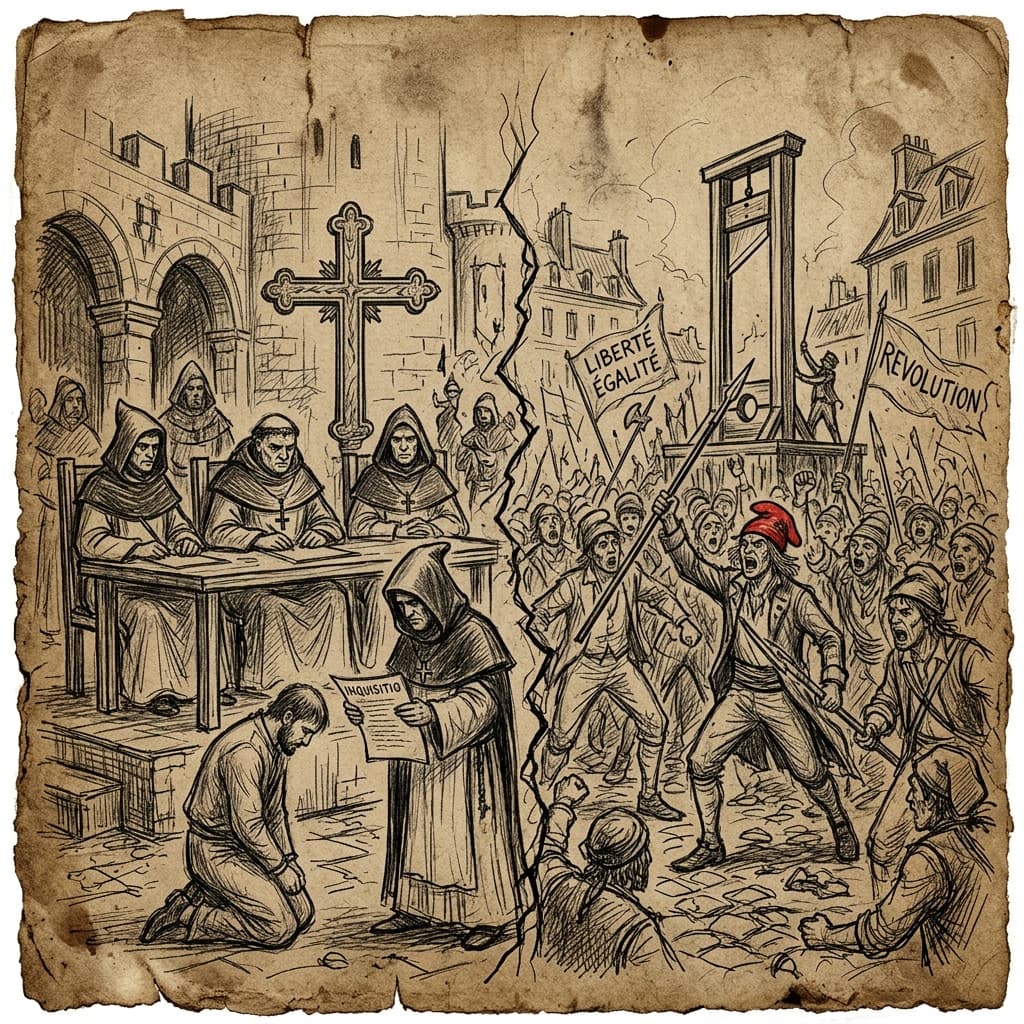
Contemporary historiography, subjected for three centuries to the ideological imperatives of rationalist Enlightenment, European Freemasonry and Anglo-Saxon geopolitical propaganda, has erected a monumental edifice of slanderous falsehoods with the deliberate purpose of perverting the civilizational memory of Hispanicity and vilifying the legal and moral institutions of the Old Regime. Whoever examines with philological rigor, paleographic discipline and documentary severity the texts taught in university lectures and that feed world public opinion immediately notices the presence of a gigantic imposture: the so-called Black Legend, that systematic fabrication of lies originally woven by the Dutch and English libelists of the sixteenth century - from libels such as the Apology of William of Orange - and magnified two centuries later by the French encyclopedists to obscure the greatest political and spiritual work of modern times. At the nerve center of this campaign of psychological manipulation of the masses and historical deformation is an apocryphal and inverted comparison between the courts of the Holy Office of the Spanish Inquisition and the advent of the French Revolution of 1789, presenting the former as the paradigm of bloodthirsty barbarism and clerical obscurantism, and the latter as the radiant dawn of freedom, civic tolerance and human rights. However, when the veil of Jacobin rhetoric is torn and one descends into the relentless accounting of the judicial archives of the National Historical Archive of Madrid, the Simancas Castle and the Vatican Secret Archive, reality emerges with a quantitative forcefulness and a moral superiority that shatters the official narrative of secularized modernity.
It is enough to contrast the figures documented by modern judicial paleography for the edifice of enlightened myth to collapse with a crash on its own foundations. During the three hundred and fifty-six years in which the court of the Spanish Inquisition operated, from its establishment in the Kingdom of Castile by papal bull of Sixtus the Fourth in one thousand four hundred and seventy-eight until its definitive abolition in one thousand eight hundred and thirty-four, the total number of capital executions in the entire scope of the Spanish Monarchy—including the Iberian Peninsula, the Mediterranean and Italian dominions, and the immense overseas viceregal territories—barely exceeded three thousand people. This unquestionable fact has been corroborated by the exhaustive historiographic census directed by the Danish scholar Gustav Henningsen, director of the Danish Folklore Archive in Copenhagen, in collaboration with the Spanish paleographer Jaime Contreras, who, after verifying forty-four thousand six hundred and seventy-four procedural lawsuits preserved between the years one thousand five hundred and forty and one thousand seven hundred, demonstrated that only one point eight percent of the processes concluded with a sentence to the secular arm, also corresponding to a significant number of them to executions in effigy on straw dolls when the accused had fled. In sharp and horrifying contrast, the French Revolution, acting in the name of deified Reason, popular sovereignty and an abstract revolutionary philanthropy, massacred in the very brief period of twelve months - during the Jacobin Terror between 1793 and 1794 - more than forty thousand men, women, elderly and children by guillotine and in summary executions in Paris and the provincial provinces. All this without counting the horrific systematic extermination of more than two hundred thousand Catholic and royalist peasants in the planned genocide of the Vendée, where the infernal columns of the Jacobin general Louis-Marie Turreau devastated entire agrarian regions for the sole crime of remaining faithful to their God, their Church and their King, implementing the infamous mass drownings of the Loire River in the city of Nantes ordered by the Commissioner Jean-Baptiste Carrier. That is to say, in a single year of ideological frenzy and under the mottos of Liberty, Equality and Fraternity, the Enlightenment shed an amount of innocent blood infinitely greater than what the Holy Office judged in fifteen generations of the Spanish Empire.