
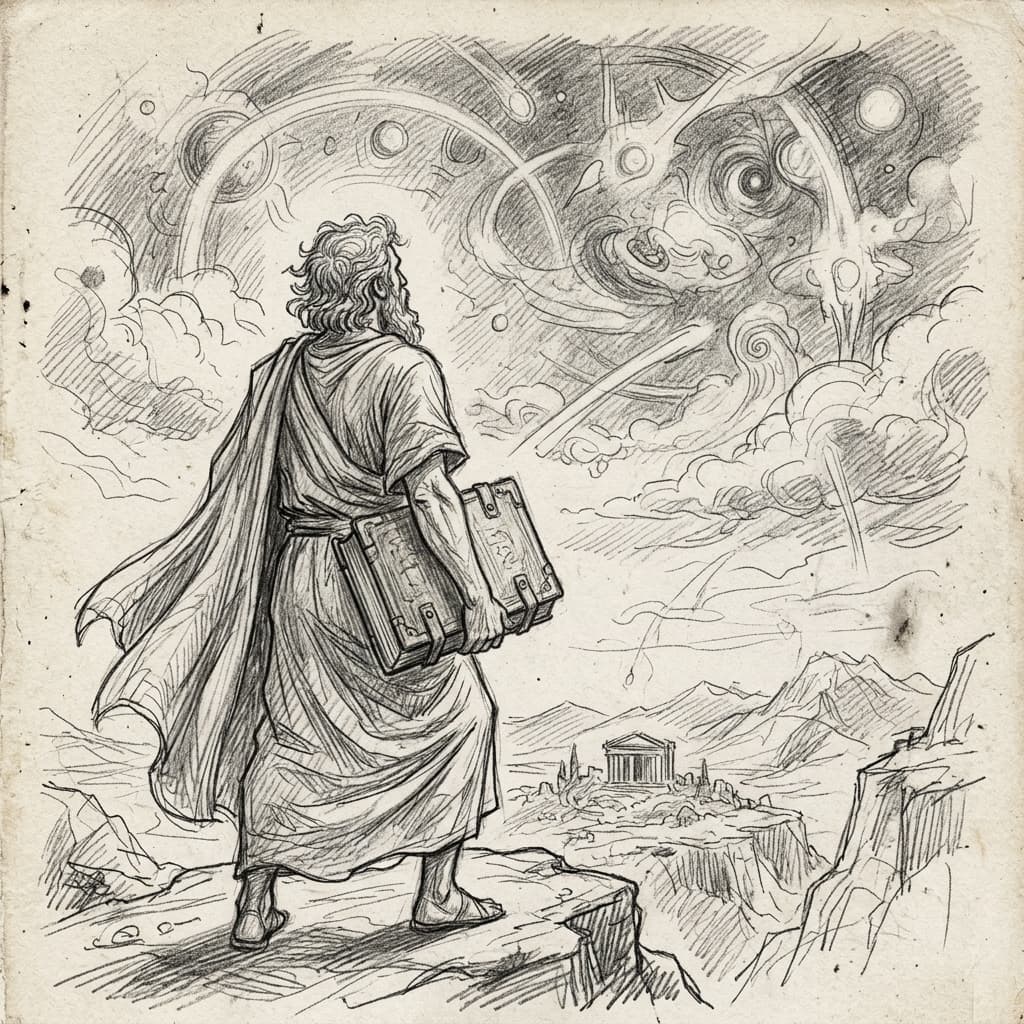
Note from the Management: This document constitutes the most ambitious intellectual and analytical effort in the history of our Publishing House. Faced with the dissolution of rational frames of reference and the growing collective fascination with Unidentified Aerial Phenomena (UAP), the board of directors has drafted a founding manifesto. This text is not a compendium of theories, but a metaphysical anchor.
PART I: THE PROBLEM IS NOT THE HEAVEN, IT IS THE MAN WHO LOOKS AT THE SKY
Few issues have generated in recent decades a cultural phenomenon as unique as the so-called UAP phenomenon (Unidentified Anomalous Phenomena) or, in classic terminology, the UFO phenomenon. What for much of the 20th century was considered a marginal issue, usually confined to the pages of speculative literature or esoteric subcultures, has progressively acquired a radically different status. This paradigm shift is not the result of a sudden intellectual fad, but rather the direct consequence of a series of historically verifiable facts: the sustained declassification of official documents that previously enjoyed the highest degree of military secrecy, the institutional recognition by hegemonic powers of the existence of unidentified aerial phenomena that violate the dynamic capabilities of known human technology, the creation of government investigative committees, the public appearances under oath of military and intelligence personnel of the highest level, and the renewed interest of academic spheres that previously observed this terrain with explicit disdain.
However, this apparent "transparency" or release of information has not brought with it the light of truth. On the contrary, we find ourselves mired in a deep epistemological darkness. The exponential growth of available information, the incessant torrent of leaked military videos and the multiplication of testimonies has not been accompanied by an equivalent growth in conceptual clarity. On the contrary, the UAP phenomenon seems to have become a gravitational vortex, a semantic black hole where cutting-edge scientific narratives, philosophical speculations, unspeakable geopolitical interests, new religious discourses of a messianic nature, esoteric movements and communication strategies driven by the dizzying dynamics of contemporary digital culture converge and mutually destroy each other.
Faced with this panorama of suffocating excess of information and profound orphanhood of meaning, the first obligation of a mind anchored in classical realism is not to blindly launch into guessing what those lights in the sky are. The question "What are UAPs?" is certainly a legitimate question, but it is also a death trap if asked in isolation. The real question, the question that defines the maturity or ruin of our civilization, is diametrically opposite: How should a human intelligence, trained in first philosophy, rigorous science and immutable theology, reason when faced with a phenomenon whose historical reality seems amply accredited, but whose ultimate nature remains tenaciously indeterminate?
This simple reformulation shifts the entire center of gravity of the problem in one fell swoop. We are no longer interrogating atmospheric anomalies; we are interrogating our own capacity to know the truth.
And it is at this exact point where we must establish our first and most unbreakable line of defense. Throughout history, the great revolutions in science and the most astonishing discoveries (from the Copernican turn to relativity and quantum mechanics) have been instrumentalized by Enlightenment and rationalism to try to demolish the edifice of Aristotelian-Thomistic metaphysics and Christian morality. We have been told that every time the universe turns out to be vaster, stranger, or older than we thought, human beings lose value. We are told, with the constancy of a poisoned mantra, that if the cosmos is populated by unknown entities, classical anthropology becomes obsolete, morality becomes relative and divine Revelation is reduced to a simple tribal myth of Bronze Age shepherds.