
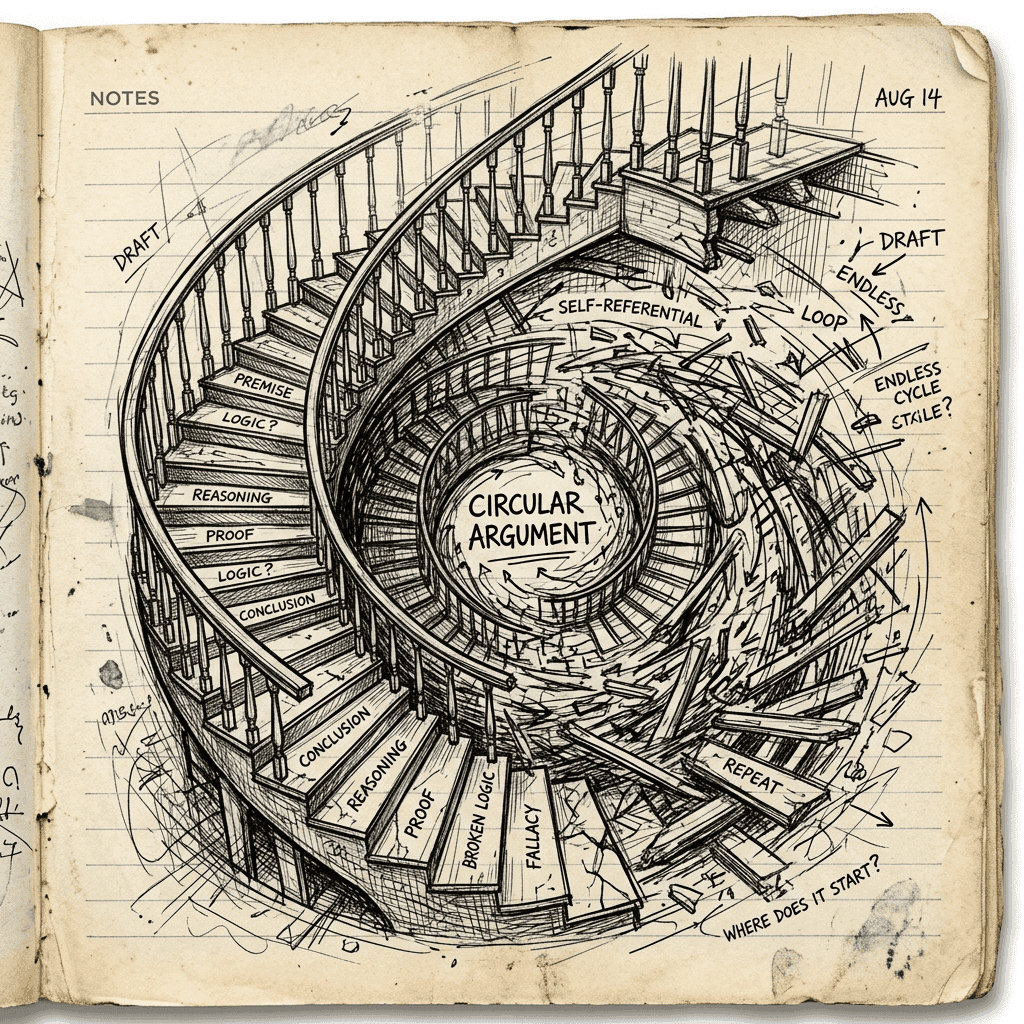
When the causal error is projected into an uncontrolled succession of unsupported presumptions, we end up in the unjustified chain of causes, a prelude to the inductive madness known as the slippery slope or domino fallacy. In these phantasmagoric constructions, the arguer weaves a chain of speculations where each link lacks logical necessity, concluding immense catastrophes from inconsequential facts in a parodic genealogy that defies all common sense. Faced with such derivations, where it is intended to connect a harmless daily act with the collapse of the universe in a direct causal line, the wisdom tradition warns us that the only decent and healthy response to the consummated plot nonsense is the lucid irony and the serene rejection of those who refuse to enter the labyrinth of the absurd.
Finally, regarding the structure and coherence of integral knowledge, we must guard against the Fallacies of Composition and Division, direct transgressions against the psychological postulates of the Gestalt and against the metaphysics of being, which demonstrate that the whole has an ontological perfection superior and different to the mere arithmetic sum of its parts. The fallacy of composition arbitrarily attributes to the whole the particular properties of its isolated elements, forgetting that the corporate harmony of an orchestra is not guaranteed by the singular virtuosity of the teachers if subordination to the supreme direction is lacking, in the same way that the union of poisonous substances separately can give rise, by synthesis, to salutary compounds essential for life. Its reverse, the fallacy of division, seeks to impose on the singular individual the global attributes of the corporation, deducing in the official the indecision that perhaps afflicts a plural cabinet precisely because of the irreducible firmness of each of their individual wills. And crowning this taxonomy of error, the Fallacy of Disproportionate Conclusion arises, the misplacement of judgment that, based on authentic premises and verifiable facts, jumps into the void with a disproportionate inductive leap, affirming as universal certainty what only constitutes a particular hypothesis, ignoring out of anxiety or ideological interest the multiple alternative and reasonable explanations that clarify the silence, caution or reserve of citizens.
With this critical apparatus from the first volume of our special on logical fallacies, we lay the normative, neuroscientific and metaphysical foundations that will guide our research. In the next five installments, our journalistic and academic body will explore in an alphabetical and exhaustive manner the thirty major pathologies of argumentation that persist on the contemporary scene, restoring the lordship of classical logic and the dignity of the word to the inseparable service of Faith, Tradition and Truth.
Legal Note: This critical analysis is carried out under the protection of Art. 28 (news of general interest) and Art. 10 (right of citation) of Law 11,723 on Intellectual Property of the Argentine Republic. The original work and its title belong to its respective author and publication medium, cited on this page.