
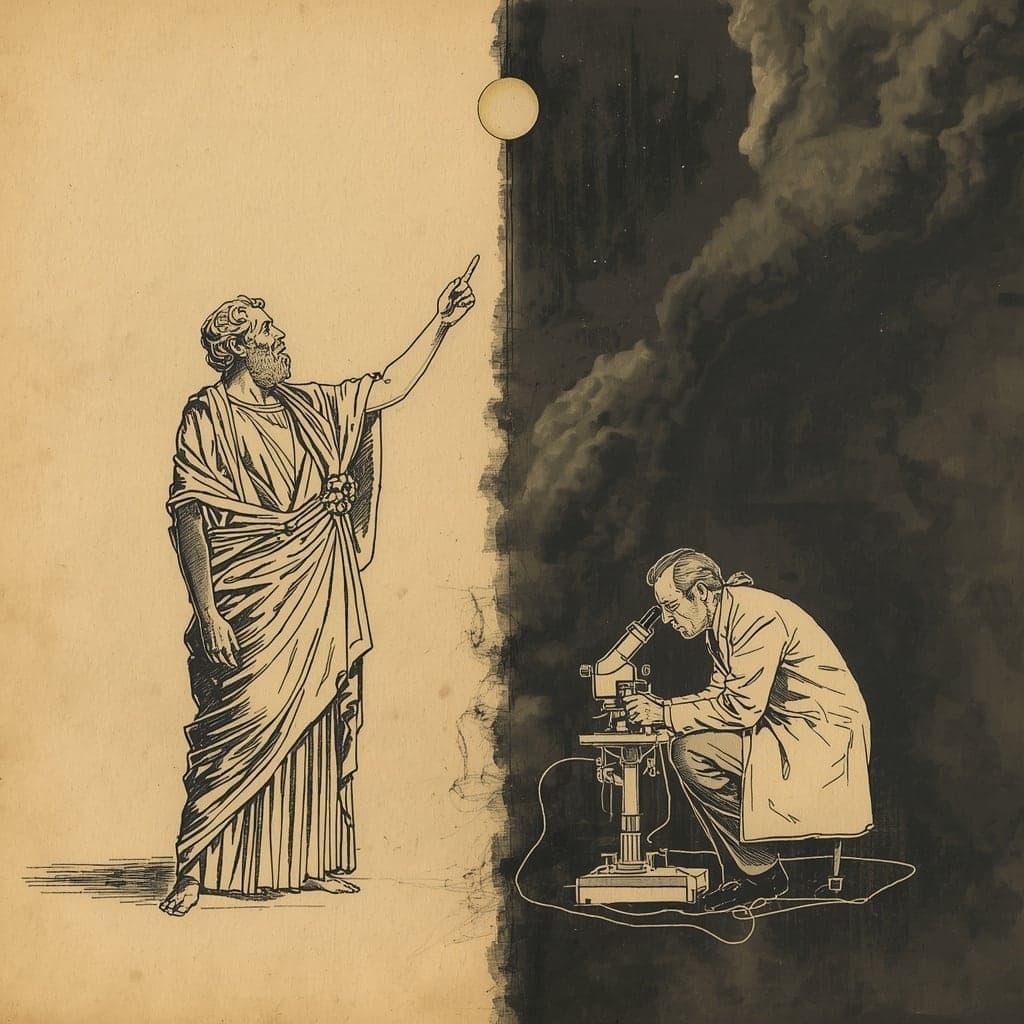
To unravel this epistemological knot, the speaker summons the perennial Magisterium of the Church, referring to the magisterial text of the encyclical Fides et Ratio promulgated by the Supreme Pontiff John Paul II in the year one thousand nine hundred and ninety-eight. This apostolic document masterfully settled the centuries-old dispute about the philosophical legitimacy of a Christian philosophy. Against the sophisms of Enlightenment rationalism that demand a wall of insurmountable separation between the natural knowledge of reason and divine Revelation, the Pope reminds the world's intellectuals that Truth is absolutely one and indivisible because it has its ultimate cause in the same Creator God, and that both reason and faith constitute the two wings with which the human spirit rises towards the contemplation of immutable truth.
Basing himself with philological audacity on number seventy-six of Fides et Ratio, Dr. Verdier practices a hermeneutical exegesis that he himself describes as an apocryphal but methodologically impeccable text: he replaces the phrase Christian philosophy with the concept of Christian psychology. As a theological thinker, I endorse this analogical transposition in an unrestricted manner, since the demand for the subordination of particular sciences to metaphysical and theological wisdom is a thousand times more urgent in clinical psychology than in abstract speculation. The speaker clarifies very neatly that talking about Christian psychology is in no way equivalent to proposing an improbable official psychology of the Church, since the Revelation is not a manual of psychiatric nosography nor a psychopharmacological vademecum. Nor is it reduced to the mere external exercise of a baptized psychologist who works in his office, avoiding transgressing the commandments.
On the contrary, the Christian name given to psychology designates an empirical science conceived in vital and dynamic union with the faith of the Church. In strict scientific terms, this implies that any scrutiny of synaptic transmission, the limbic system or the psychopathology of affects must be developed illuminated and protected by theological anthropology. A genuine Christian psychology gratefully embraces all the legitimate discoveries of the empirical method that would never have seen the light of day without the intellectual climate of Christianity, but subjects its conclusions to the supreme sieve of Revelation. Faith acts in this process as a powerful epistemological lighthouse that protects the researcher from sinking into the abysses of materialism and allows him to visualize dimensions of human suffering that the electron microscope and the tomograph will never be able to record.
We thus arrive at the problematic core of our first investigation: what specifically theological light contributes to empirical psychological science. On the strict plane of the natural order, discursive reason is capable of articulating a true but incomplete philosophical anthropology. It is only faith that gives the scientist a complete theological anthropology, that is, the indisputable knowledge of what God reveals about man, his origin, his fall through original sin and his vocation to eternal glory. From the neurobiology laboratories we confirm daily that pure and simple positive science systematically leaves loose ends; He is capable of describing in remarkable detail the biochemical mechanism of pain or anguish, but remains silent with impotent astonishment when faced with the question of the teleological meaning of that same pain.